Subterranean termites, particularly invasive Formosan colonies native to maritime trade corridors, build massive underground networks that systematically exploit hairline expansion joints in South Florida concrete…
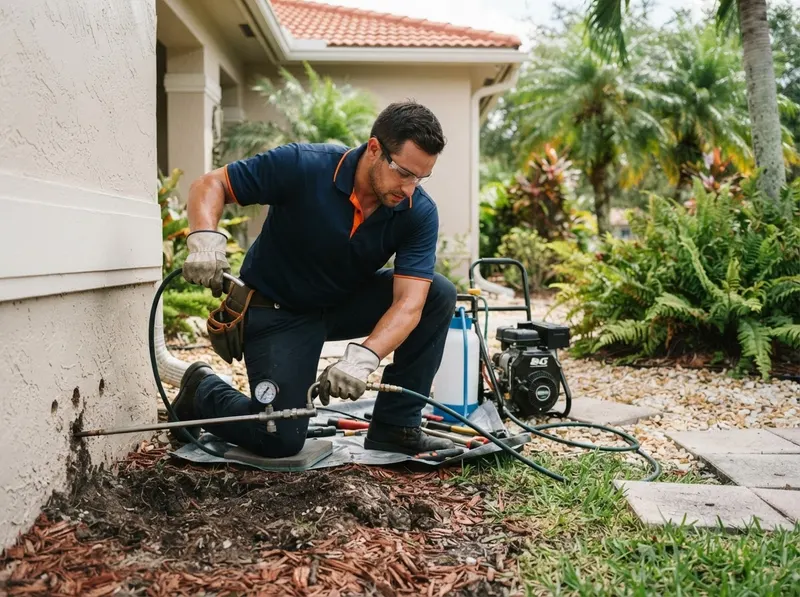
Subterranean termites, particularly invasive Formosan colonies native to maritime trade corridors, build massive underground networks that systematically exploit hairline expansion joints in South Florida concrete slabs. According to the Florida Department of Agriculture and Consumer Services, subterranean termites represent one of the primary structural wood-destroying organisms requiring licensed containment across the state. A standard defensive installation requires creating a continuous liquid chemical zone in the exterior perimeter dirt using non-repellent active ingredients such as fipronil, which the United States Environmental Protection Agency regulates under federal pesticide containment guidelines. For homes situated near high water tables along the Middle River in Royal Palm Isles or Lloyd Estates, soil treatments require exact depth calibration to protect local soil while binding tightly to organic matter around stem walls.
Soil treatment involves digging a 6-inch by 6-inch continuous trench along the exterior stem wall foundation and applying liquid termiticides at a standard calculated rate of 4 gallons per 10 linear feet per foot of depth, adhering strictly to the USDA Agricultural Research Service subterranean defense protocol standards. Where exterior slabs, carports, or entryways abut the home, common in mid-century construction across Corals, Central Corals, and Prospect Park, technicians drill vertical 0.5-inch holes spaced every 12 inches through concrete to inject the barrier underneath. Homeowners researching wood structural preservation through the Forest Products Laboratory understand that subterranean treatment protects against ground-up colony tunneling, whereas drywood termites land directly on elevated roofs and fascia without needing soil contact.
Wood-specific treatments act as an internal shield for accessible wall framing, attic trusses, and floor joists using disodium octaborate tetrahydrate. This mineral salt penetrates the natural moisture channels of lumber, making the wood completely indigestible to cellulose-consuming insects as detailed in structural defense technical bulletins from the Pest Control Technology Magazine. For existing buildings in Oakland Forest and Lake Ridge Falls undergoing interior renovation, spraying or foaming exposed studs with borates leaves a permanent protective matrix that does not off-gas volatile organic compounds, aligning with green residential construction guidance established by the U.S. Green Building Council. When drywood galleries are localized inside door jambs or exposed eaves, technicians drill precision 1/8-inch test holes directly into structural hollows to inject localized non-repellent foams that transfer among nesting insects via grooming behaviors documented by the University of Florida Entomology Department.
Local architectural features throughout North Andrews Gardens, such as low-clearance crawl spaces and ground-level patio extensions, require specific application equipment including hydraulic sub-slab injection rods and foaming expansion generators. While the minimum diagnostic and containment visit fee is $250, whole-structure treatments must be measured against physical linear dimensions and soil porosity. Structural defense decisions depend on construction type: a slab-on-grade block home requires deep sub-slab perimeter rodding to halt subterranean foragers, whereas two-story framed additions demand full attic borate misting to counter wind-blown reproductive swarmers during warm spring flights tracked regionally through the UF IFAS Extension EDIS database. Municipal residential codes maintained by the City of Oakland Park ensure that subterranean plumbing penetrations do not breach foundational integrity, which HomeFront Pest Solutions reinforces by targeting utility slab cutouts with pressurized foam barriers to stop termites where hidden moisture accumulates. For national property maintenance standards referenced by the National Pest Management Association, combining long-term soil barriers with active wood impregnation delivers measurable multi-year perimeter defense without disruptive structural tenting.
Every job gets a firm, written price after a free on-site visit.
For standards, safe disposal, and service guidance on pest control services in Oakland Park, FL, useful references include U.S. EPA, ENERGY STAR, U.S. Dept. of Energy, Consumer.gov, U.S. Census Bureau, and Google Maps. General consumer and small-business resources are available from USA.gov, Better Business Bureau, FTC Consumer Advice, U.S. Small Business Administration, and Ready.gov.
Tell us about your termite soil & wood treatment job in Oakland Park and we'll send a clear, written quote, usually the same day.
 HomeFront Pest Solutions