Subtropical heat and constant humidity accelerate biological decay when rodents or wildlife penetrate residential rooflines across Broward County. In neighborhoods like Lloyd Estates and North Andrews Gardens, roof…
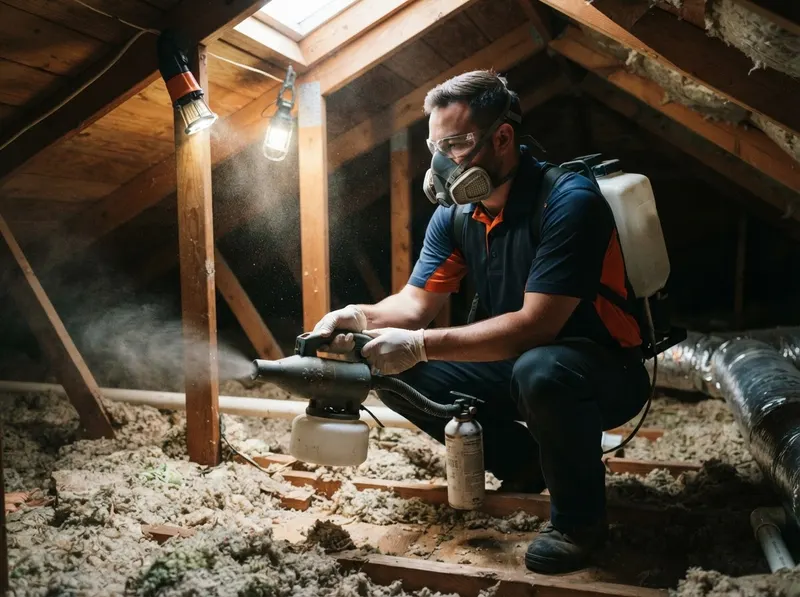
Subtropical heat and constant humidity accelerate biological decay when rodents or wildlife penetrate residential rooflines across Broward County. In neighborhoods like Lloyd Estates and North Andrews Gardens, roof rats and raccoons exploit mature oak canopies to access fascia boards, depositing urine, fecal droppings, and ectoparasites directly above drywall ceilings. Attic sanitation and decontamination in Oakland Park functions as a defensive countermeasure, neutralizing biological vectors before ambient attic temperatures, frequently exceeding 130 degrees Fahrenheit, vaporize biological contaminants into central duct systems. Unsanitized animal refuse emits aggregation pheromones that continuously attract secondary pests, meaning surface trapping alone leaves homes vulnerable to recurrent infestation.
Remediation begins with negative-pressure containment protocols outlined by the Occupational Safety and Health Administration to keep airborne dust from entering living quarters. Technicians remove dry feces and nesting material using high-efficiency particulate air vacuums certified under U.S. Environmental Protection Agency standards to prevent microscopic particles like hantavirus and salmonella from circulating. In ranch-style structures across Central Corals and Royal Palm Isles, contaminated, compressed insulation loses thermal resistance values designated by the U.S. Department of Energy, forcing cooling units to run continuously. Our teams strip compromised fiberglass, expose bare joists, and systematically decontaminate the substrate.
Substrate clearance follows rigid standards from the Centers for Disease Control and Prevention, utilizing botanical enzyme biocides applied through atomized ULV misting machines. This application eradicates bacteria, fungal mold spores, and mite vectors adhering to framing lumber. To prevent future breaches, structural vulnerability points along ridge vents, drip edges, and soffits receive heavy-duty hardware cloth and polymer sealants, adhering to residential fire codes from the National Fire Protection Association. In waterfront pockets such as Lake Ridge Falls and Prospect Park, high coastal water tables force pests vertical, making physical exclusion an indispensable structural safeguard.
Proper remediation requires specialized equipment and handling techniques that consumer tools cannot match. Homeowners running retail shop vacuums inadvertently disperse pulverized biological waste into the air, while store-bought aerosol sanitizers fail to penetrate the porosity of aged spruce and pine framing. Professional treatment adheres to Florida Department of Agriculture and Consumer Services guidelines alongside residential standards published by the National Pest Management Association. Contaminated insulation disposal complies with non-hazardous solid waste transfer rules defined by the Florida Department of Environmental Protection and coordinated with local Broward utilities outlined by Broward County Solid Waste and Recycling, while all ceiling and building assembly adjustments match wind-load mandates from the Florida Building Commission.
Every job gets a firm, written price after a free on-site visit.
For standards, safe disposal, and service guidance on pest control services in Oakland Park, FL, useful references include U.S. EPA, ENERGY STAR, U.S. Dept. of Energy, Consumer.gov, U.S. Census Bureau, and Google Maps. General consumer and small-business resources are available from USA.gov, Better Business Bureau, FTC Consumer Advice, U.S. Small Business Administration, and Ready.gov.
Tell us about your attic sanitation & decontamination job in Oakland Park and we'll send a clear, written quote, usually the same day.
 HomeFront Pest Solutions